
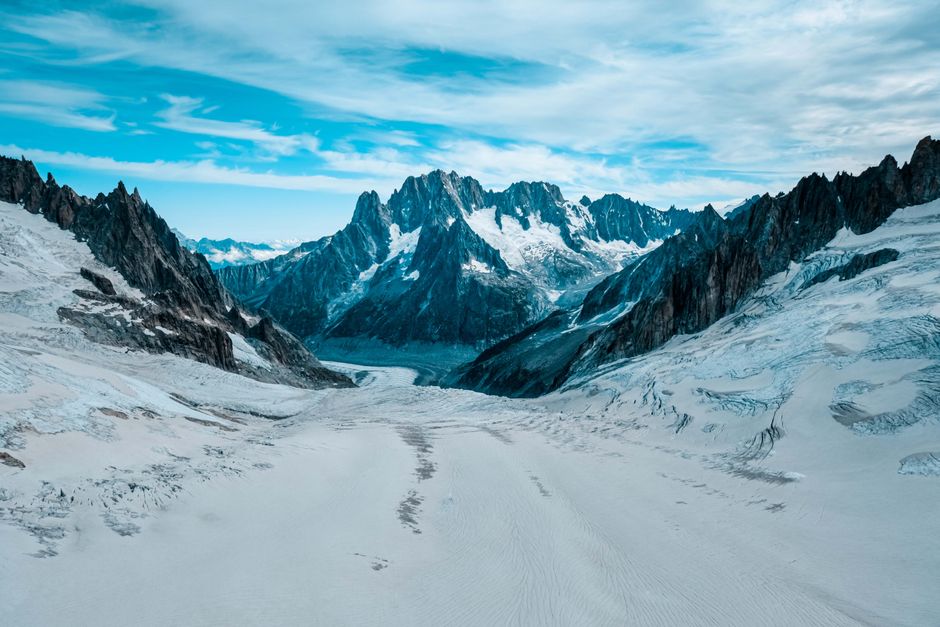
A cable car can leave you less than 700 vertical metres below a 4,164-metre summit. That sounds like a hike, but Breithorn still crosses a glacier and demands real mountain skills. Fit hikers have several safer first-summit choices around Mont Blanc, yet the best option depends on the skill you want to learn, not just the height you want to post online.
The best first summit depends on the skill you want to learn
These peaks are realistic targets for strong hikers who train properly and go with a qualified mountain guide. They are not interchangeable. A short glacier ascent can be more serious than a long trail on dry rock.
Shortlist for a first Alpine summit
| Summit | Height | Typical plan | Main challenge | Best for |
|---|---|---|---|---|
| Breithorn West | 4,164m | 1 day, 2–4 hours from Klein Matterhorn | Glacier travel and altitude | First 4000m summit |
| Allalinhorn | 4,027m | 1 day from Mittelallalin | Glacier plus summit ridge | Learning rope skills |
| Gran Paradiso | 4,061m | 2 days from a mountain hut | Longer ascent and exposed final rocks | Best overall first climb |
| Aiguille du Tour | 3,540m | 2 days | Glacier approach and easy scrambling | First Mont Blanc-area alpine route |
My clear pick
For the easiest first 4000m summit, choose Breithorn West with a guide; the official Zermatt route information confirms that the cable car makes the ascent unusually short. For the best training value, choose Gran Paradiso. It involves a hut night, glacier movement, pacing, and a short exposed summit finish.
Fitness gets you to the hut; technique gets you home
My verdict: strong legs are only half the entry ticket. A fit hiker can climb 1,200 metres in a day and still be unready for a crevasse, hard snow, a fixed rope, or a crampon that catches a trouser leg.
What fitness should look like
Before booking, complete a 1,000–1,500-metre mountain day with a 8–12kg pack and finish with enough control to descend safely. You should also handle six to eight hours on your feet without losing focus. Alpine summits punish the last hour, not the first climb.
What technique should look like
Take a one-day crampon and ice-axe course before the summit attempt. Learn the French technique for walking on moderate snow, how to arrest a slip, how to move while roped, and how to cross a snow bridge. A guide can teach these skills quickly, but a guide cannot make a tired client react well to a fall.
Altitude adds another problem. At 4,000 metres, breathing feels harder even on easy ground. Spend two or three nights above 2,000 metres before the summit day, keep the first day gentle, and turn around for headache, nausea, poor coordination, or unusual fatigue.
Route reality: glacier, rock, and altitude are different tests
A first Alpine summit should teach one demanding skill at a time. That is why route descriptions matter more than labels such as easy or moderate. “Easy” often describes the climbing grade, not the consequence of a mistake, the length of the day, or the condition of the glacier.
Breithorn tests altitude and glacier habits
Breithorn West is a broad, snow-covered summit reached from the Matterhorn Glacier Paradise station. The approach is short, which lowers the endurance cost, but it also starts near 3,800 metres. Some hikers feel the altitude immediately. The route normally uses crampons and a rope. Crevasses can open or change during the season, so a track that looked simple in a photograph is not a route to copy alone.
Gran Paradiso tests pacing and movement
Gran Paradiso rises to 4,061 metres in Italy’s national park. The normal route climbs from the Vittorio Emanuele II or Chabod hut, crosses a glacier, and finishes on a narrow rocky ridge near the summit statue. The Valle d’Aosta route description lists both standard hut approaches. This is my preferred learning route because the climb feels like a small expedition rather than a cable-car outing.
Aiguille du Tour tests judgement on mixed terrain
Aiguille du Tour is lower at 3,540 metres, but it includes glacier travel, snow, and easy rock. That mix makes it excellent preparation for harder Mont Blanc-area routes. It is not automatically safer because it is lower. Rockfall, route-finding, thin bridges, and changing snow can create more work than a straightforward 4000m glacier route. Choose it when you want practical Alpine movement, not simply a high summit number.
The failure mode to avoid is choosing by elevation alone. A lower peak with poor weather, soft snow, or a complex descent can be a worse first day than a higher route in stable conditions.
My ranking for a first Alpine summit
Choose Gran Paradiso for the best balance of learning, scenery, and genuine summit experience. Breithorn wins only when the main goal is reaching a first 4000m peak with the smallest time commitment.
- Gran Paradiso: Best overall. The hut approach, glacier, long summit day, and short exposed finish build useful skills without Mont Blanc’s scale.
- Breithorn West: Best for a first 4000m summit. Use a guide, practise crampons beforehand, and treat the short route as a high-altitude mountaineering day.
- Allalinhorn: Best for a compact Swiss trip. It starts high from Saas-Fee, but the glacier and summit ridge still require rope work and careful pacing.
- Aiguille du Tour: Best for mixed terrain. Pick it when you want glacier and scrambling practice more than a four-thousand-metre tick.
- Weissmies: A strong next step. Its 4,017-metre summit and longer snow ridge suit hikers who already understand crampons and roped travel.
Skip Mont Blanc itself as a first Alpine summit if you have no glacier experience. The normal route is long, exposed, crowded, and sensitive to weather, rockfall, and acclimatisation.
How to prepare in eight weeks
Train for the exact demands of the route, not for a generic fitness target.
- Weeks 1–2: Build two weekly uphill sessions and one long mountain day. Add 500–800 metres of ascent at first, then increase gradually.
- Weeks 3–4: Carry 8–12kg on a six-hour hike. Practise descending while tired. Poles help on the approach, but keep both hands free when using an ice axe.
- Weeks 5–6: Take a crampon and ice-axe course. Practise stopping a slide, moving in a rope team, and walking on firm snow. Do not learn these skills at the summit start.
- Week 7: Complete your hardest training day, ideally 1,200 metres of ascent with a dawn start. Test boots, gloves, layers, sunglasses, and food.
- Week 8: Reduce volume, sleep well, and acclimatise at altitude. Check the guide’s weather and route update the evening before departure.
The common mistake is adding hard sessions until the final day. Arrive rested. A slightly lower training load and good sleep beat one heroic workout.
Questions that prevent a bad first summit
Is Breithorn safe for a fit hiker with no mountaineering experience?
It can be a realistic guided introduction, but fitness alone is not enough. You still need proper boots, crampons, warm layers, and a guide who checks the glacier conditions. Treat the trip as mountaineering, not sightseeing.
Should I choose a private guide or a group?
Choose a private guide if you need a slower pace, have little snow experience, or want to learn specific skills. A small group costs less and works well for a confident hiker who can match the advertised pace. Ask about the maximum group size, guide ratio, cancellation policy, and what equipment the fee includes.
When should I cancel?
Cancel or postpone for unstable weather, poor visibility, unsafe glacier conditions, illness, or a guide’s concern about your pace. A summit is optional. The mountain will still be there, while a rushed descent can create the day’s greatest risk.
The opening cable-car scenario now has its proper answer: a short approach to 4,164 metres can be a sensible first summit, but only when the hiker respects the glacier, trains the missing skills, and lets conditions choose the final plan.